
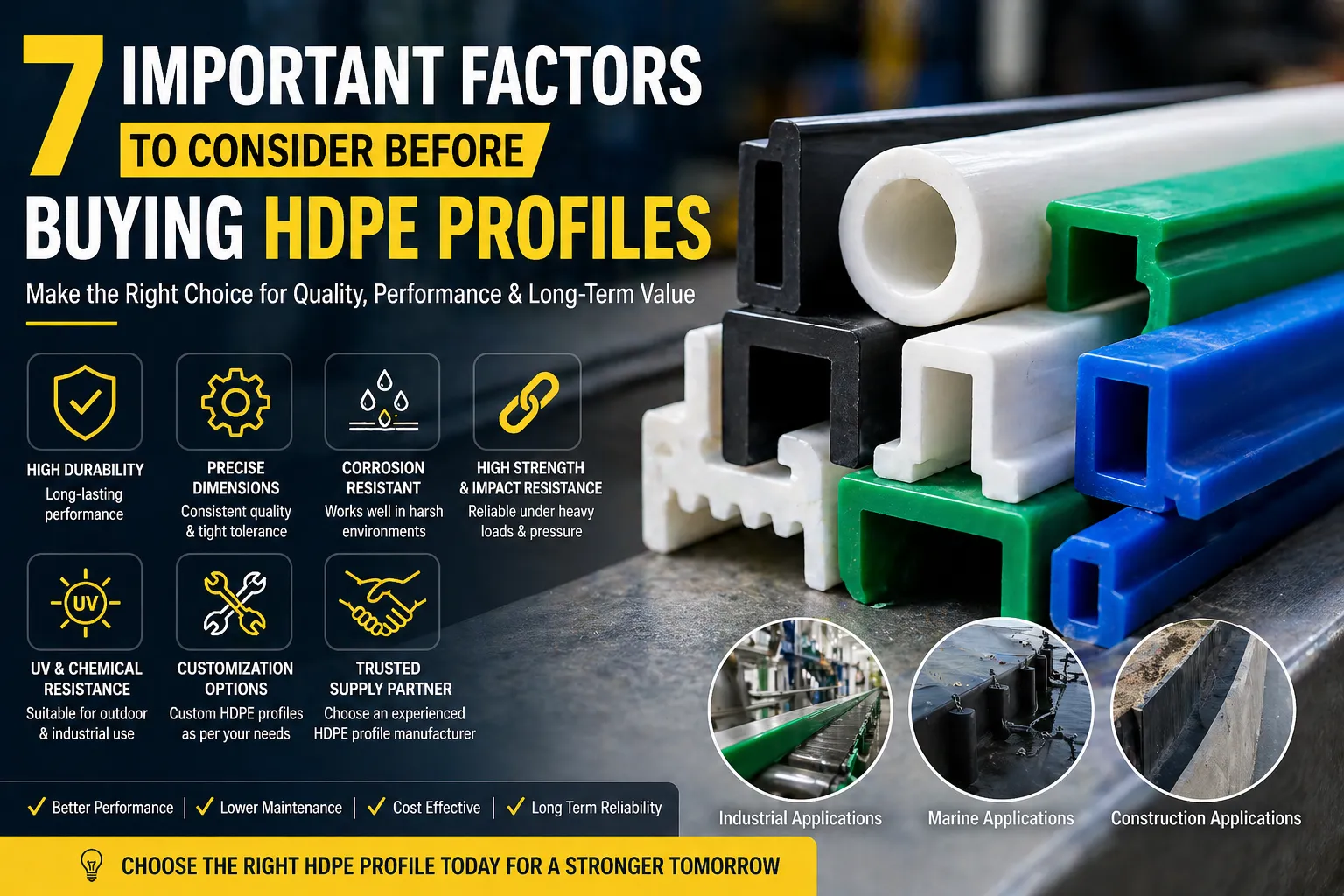

A few years ago, I visited a fabrication unit that had just replaced an entire batch of plastic guides in their conveyor system. The reason? The profiles warped under load within weeks. They had chosen the cheapest option without checking material grade or extrusion quality.
That is exactly why buying HDPE profiles should never be rushed.
When working with the right HDPE profile manufacturer in India, you quickly realise that not all HDPE plastic profiles perform the same. High-density polyethylene is a strong and reliable material, but only if it is processed correctly and designed for the right application.
If you are sourcing for industrial use, bulk projects, or repeat production, here are seven important factors you must check.
1. Understand the Application First
Before buying HDPE profiles, ask one simple question:
Where and how will this profile be used?
HDPE extrusion profiles are commonly used in:
- Conveyor guides
- Marine dock fenders
- Wear strips
- Packaging lines
- Construction protection elements
Each application has different load, friction, and temperature conditions.
Quick answer:
Always match the HDPE profile design and density grade to the working environment.
I have seen profiles perform perfectly in dry indoor settings but fail in high-friction conveyor systems because the design did not consider wear rate.
2. Check the Grade of High-Density Polyethylene
Not all high-density polyethylene profiles are made from the same raw material grade.
Key checks:
- Virgin vs recycled content
- Density level
- UV stabilisation (for outdoor use)
- Impact strength
For industrial HDPE profiles used outdoors, UV-stabilised material is critical. Without it, long-term exposure causes surface cracking.
Personal judgement here: I generally recommend avoiding unknown recycled blends for load bearing industrial use. The short-term savings rarely justify the long-term risk.
3. Confirm Dimensional Accuracy and Tolerance
When buying HDPE profiles in bulk, dimensional consistency matters more than most buyers think.
Ask your HDPE profile supplier for:
- Technical drawings
- Tolerance range
- Batch consistency assurance
Even a 1 mm variation can create fitting issues in machinery tracks or structural frames.
What usually works:
Manufacturers who control tooling and extrusion parameters in house maintain better repeat accuracy.
What often fails:
Outsourced extrusion with inconsistent die maintenance.
4. Evaluate Mechanical Properties
HDPE is known for toughness and chemical resistance. But profiles must meet real load conditions.
Important properties to verify:
- Tensile strength
- Impact resistance
- Wear resistance
- Flexural modulus
For example, industrial HDPE profiles used as guide rails must resist continuous friction.
Short answer:
Request mechanical property data sheet before finalising large orders.
If the supplier cannot provide basic technical data, that is a warning sign.
5. Consider Customisation Capability
Many buyers require custom HDPE profiles designed for specific machinery or construction needs.
Customisation includes:
- Unique cross section shapes
- Defined wall thickness
- Pre drilled holes
- Specific colours
- Length cutting precision
A reliable HDPE profile manufacturer should support custom tooling development and repeat production.
In my experience, standard off the shelf shapes rarely fit perfectly in specialised industrial systems.
6. Check Production Capacity and Repeat Supply
Large projects often require thousands of metres of HDPE extrusion profiles over time.
Before buying HDPE profiles, confirm:
- Monthly production capacity
- Lead time
- Raw material sourcing stability
- Batch tracking system
For long term industrial supply, consistency matters more than speed.
At M3 Extrusion, we have seen clients return not because of price, but because repeat batches matched exactly with their original specification.
That kind of stability builds trust.
7. Compare Total Cost, Not Just Price Per Metre
It is tempting to compare suppliers only on price.
But consider total lifecycle cost.
| Factor | Low Cost Option | Quality HDPE Profile |
|---|---|---|
| Wear rate | Faster | Slower |
| Replacement cycle | Frequent | Reduced |
| Downtime risk | Higher | Lower |
| Overall cost | Often higher | More stable |
When buying HDPE profiles for industrial use, downtime costs far more than material cost.
One broken guide rail in a production line can stop operations for hours.
Common Mistakes Buyers Make
Based on two decades in extrusion manufacturing, here are recurring mistakes:
- Ignoring application load requirements
- Skipping sample testing
- Not checking UV stabilisation
- Overlooking dimensional tolerance
- Choosing suppliers without long term capacity
Most of these problems are preventable with proper pre purchase evaluation.
How to Select the Right HDPE Profile Supplier
Here is a practical checklist:
Step 1: Review Technical Documentation
Request material data sheets and extrusion drawings.
Step 2: Test a Sample
Check fit, rigidity, and surface finish.
Step 3: Inspect Surface Quality
Look for smooth extrusion, no bubbles, and uniform colour.
Step 4: Confirm Repeat Production
Ask how the manufacturer controls tooling and batch variation.
Step 5: Evaluate Communication
Clear technical communication often reflects internal production control.
A professional HDPE profile supplier should answer technical questions confidently.
Where HDPE Profiles Perform Best
HDPE plastic profiles are ideal for:
- Wet environments
- Chemical exposure areas
- High impact zones
- Sliding applications
- Marine structures
Their low friction surface and high durability make them suitable for long term industrial applications.
However, HDPE is not ideal for very high temperature applications. That is where material selection must be carefully reviewed.
Real World Example
A packaging company once switched to cheaper HDPE extrusion profiles for conveyor wear strips.
Within three months, the strips showed uneven wear and caused product misalignment. The issue was not HDPE as a material. It was poor grade selection and inconsistent extrusion.
After switching to higher grade industrial HDPE profiles with proper tolerance control, the problem stopped.
Lesson learned: material quality and extrusion control matter.
Final Thoughts
Buying HDPE profiles is not complicated, but it requires attention to detail.
Focus on:
- Material grade
- Mechanical strength
- Dimensional accuracy
- Customisation support
- Repeat production stability
If those factors are handled properly, HDPE becomes one of the most reliable engineering plastics for industrial use.
From my experience, careful evaluation at the start saves time, money, and operational stress later.
FAQs
1. What should I check first when buying HDPE profiles?
Start with application requirements and material grade. Confirm whether the profile will face load, friction, or outdoor exposure. Matching the right HDPE grade to the environment is the most important first step.
2. Are HDPE extrusion profiles suitable for outdoor use?
Yes, if they are UV stabilised. Standard HDPE without UV protection may degrade over long term sun exposure. Always confirm UV additive presence for outdoor applications.
3. Can HDPE profiles handle heavy industrial loads?
Industrial HDPE profiles can handle moderate loads and impact. However, proper thickness and grade selection are critical. Always verify tensile and flexural strength specifications before bulk purchase.
4. Why is dimensional tolerance important in HDPE profiles?
Small variations can affect installation and machine alignment. In bulk industrial orders, consistent extrusion ensures smooth assembly and reduces downtime caused by fitting issues.
5. Are custom HDPE profiles better than standard shapes?
For specialised machinery or construction use, custom HDPE profiles often provide better fit and performance. Standard shapes may require modification, which increases installation time.
6. How do I choose a reliable HDPE profile supplier?
Look for technical documentation, consistent production capacity, tooling control, and sample testing support. A transparent manufacturing process usually indicates long term reliability.
7. Is cheaper HDPE always a good option?
Not always. Lower cost material may contain inconsistent blends or poor extrusion control. Over time, faster wear and higher replacement frequency can increase overall costs.